

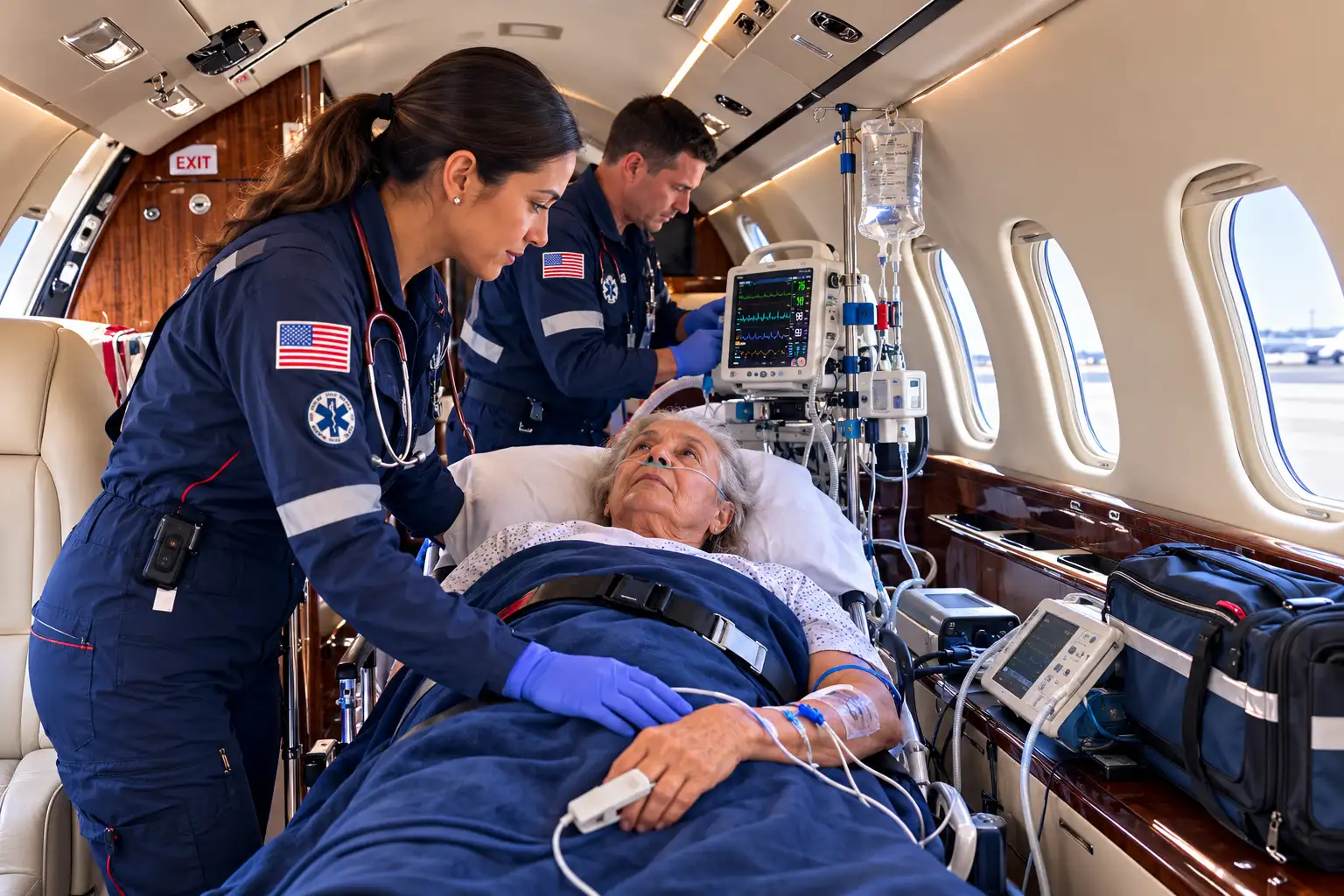
When a patient cannot travel seated, families and care teams may hear about two very different options: commercial airline stretcher transport and fixed-wing air ambulance transport.
Both can involve a patient lying flat during air travel. They are not the same transport environment.
Commercial airline stretcher transport uses space inside a scheduled passenger aircraft when the airline, route, medical review, cabin configuration, escort requirements, and operational conditions allow. A fixed-wing air ambulance is medically configured for patient transport and is planned around the patient’s route, timing, positioning, medical support, equipment, and bed-to-bed needs.
Quick Answer
Commercial airline stretcher transport may be appropriate for selected stable patients when airline medical review, schedule, routing, stretcher installation, escort arrangements, oxygen requirements, and ground transfers can be aligned.
Fixed-wing air ambulance transport may be more appropriate when the patient needs a medically configured aircraft environment, more direct patient access, oxygen planning, monitoring, secured medical equipment, controlled positioning, international or long-distance routing flexibility, or coordinated bed-to-bed transport management.
The decision should remain guided by the patient’s treating physicians and appropriate care teams.
Why the Difference Matters
The main question is not only whether the patient can lie down during the flight.
The practical question is whether the full transport environment can support the patient’s anticipated needs from origin to destination.
Commercial airline stretcher transport remains part of the passenger-airline system. It can depend on airline approval, available routes, aircraft cabin configuration, medical documentation, escort requirements, airport logistics, passenger-flight schedules, and airline-specific rules.
Fixed-wing air ambulance transport is planned as a medical transport environment from the start, with aircraft suitability, medical team configuration, equipment needs, oxygen planning, routing, airport suitability, ground transportation when included, and receiving-side coordination reviewed around the patient’s condition.
How Commercial Airline Stretcher Transport Works
Commercial airline stretcher transport generally uses a stretcher space arranged inside a scheduled passenger aircraft.
Depending on the airline and route, planning may require medical forms, airline medical review, stretcher availability, cabin configuration, oxygen arrangements, medical escort planning, seat-blocking or stretcher installation, airport assistance, and coordination of ground transportation before and after the flight.
Because the patient is traveling within the commercial-airline system, timing and routing depend on scheduled flights, airline policies, aircraft configuration, and whether the airline can accept the patient for that specific itinerary.
For some stable patients, this may be a reasonable option when all requirements align.
Where Commercial Airline Stretcher Transport May Be Limited
Commercial airline stretcher transport can become difficult when the patient’s needs exceed what a scheduled passenger flight can support.
Limitations may involve:
- airline-specific medical review and approval requirements
- limited route or aircraft availability for stretcher setup
- dependency on scheduled commercial flights
- airport transfers and terminal movement
- stretcher installation or seat-blocking requirements
- limited direct patient access compared with a dedicated medical transport environment
- oxygen equipment or oxygen-service limitations
- limited space for medical equipment or positioning needs
- ground transportation coordination before and after the flight
- possible delays if documentation, airline approval, or schedule requirements do not align
These are not reasons to reject commercial stretcher transport in every case. They are reasons to review whether the option fits the patient’s condition, route, timing, and support needs.
What a Fixed-Wing Air Ambulance Provides
A fixed-wing air ambulance is medically configured for patient transport.
Depending on the case, the transport plan may include stretcher positioning, oxygen planning, secured medical equipment, monitoring, appropriate power support, direct patient access for the medical team, aircraft-specific loading and unloading arrangements, ground transportation when included, and coordination between sending and receiving facilities.
Air Medical Transport provides complete bed-to-bed fixed-wing air ambulance transport management so families and care teams have one dedicated point of contact instead of trying to coordinate each part alone.
Our Flight Coordinator Specialists manage each transport through selected FAA Part 135 and/or EASA-certified fixed-wing air ambulance operators, coordinating transport planning, medical logistics, and regulatory requirements.
When Fixed-Wing Air Ambulance Transport May Be More Appropriate
Fixed-wing air ambulance transport may need review when the patient:
- cannot sit upright safely
- requires stretcher transport with medical support during flight
- needs oxygen planning, monitoring, medication access, or equipment support
- requires controlled positioning or more direct patient access
- is bed-bound, severely weak, or medically fragile
- has complex cardiac, respiratory, neurologic, postoperative, oncology, bariatric, geriatric, pediatric, or neonatal considerations
- needs international, intercontinental, or long-distance transport
- requires bed-to-bed coordination from origin to destination
- may not fit the schedule, route, cabin, or approval limits of commercial airline stretcher transport
For a broader decision framework, review When Is Fixed-Wing Air Ambulance Transport Appropriate?.
Cost and Planning Considerations
Commercial airline stretcher transport may sometimes appear simpler or less costly, but the comparison should not be based on the air segment alone.
Families and care teams may also need to consider medical escort arrangements, airline medical review, stretcher installation, oxygen arrangements, airport assistance, ground transportation, route availability, schedule limitations, documentation, and the patient’s ability to tolerate the commercial-airline environment.
Fixed-wing air ambulance cost is quoted individually based on transport distance, aircraft suitability, routing, airport access, ground transportation needs, medical team configuration, equipment needs, and the patient’s clinical requirements.
The right comparison is not only price. It is whether the complete transport environment fits the patient’s needs.
What This Means for Families and Care Teams
If you are comparing commercial airline stretcher transport with fixed-wing air ambulance transport, it is understandable to feel unsure. Both options can sound similar at first because both may involve a patient lying flat during travel.
The difference is whether the overall transport environment can support the patient’s needs from origin to destination.
If the patient’s needs are limited, stable, and compatible with airline requirements, commercial airline stretcher transport may be worth discussing with the treating team and airline. If the patient needs a medically configured aircraft environment, coordinated bed-to-bed logistics, oxygen planning, monitoring, equipment support, or more controlled transport planning, a fixed-wing air ambulance review may provide clearer next steps.
For more context on when standard passenger travel may no longer fit, review When Commercial Air Travel May No Longer Be Appropriate for a Medically Vulnerable Patient.
What Happens Next
If the patient may need stretcher transport, oxygen planning, monitoring, controlled positioning, medical equipment, or coordinated bed-to-bed logistics during a long-distance or international trip, begin with a fixed-wing air ambulance review.
You do not need full details to begin. Start with your contact details, the patient’s condition, location, and destination, and we will help identify the information needed for a quote.
For a fuller overview of the complete transport sequence, review What Happens During a Complete Bed-to-Bed Fixed-Wing Air Ambulance Transport.
Medical Disclaimer
This content is for informational purposes only and does not replace medical advice. Fitness for air travel should be determined by the patient’s treating medical team.
Reviewer
Reviewed for operational accuracy by:
Xavier Paz
Director / CEO, Air Medical Transport
Review scope:
Fixed-wing air ambulance transport management, medical logistics coordination, aviation coordination, and operational accuracy.
Review date:
August 25, 2026

0 Comments