


When a patient needs care at a specialty center far from home, the transport decision can become part of the medical plan.
Families and care teams may be trying to reach an oncology center, rehabilitation hospital, neurological program, complex-care hospital, pediatric or neonatal unit, palliative destination, or another specialized facility. The question is not only where the patient needs to go. It is whether the patient’s condition can be supported safely and realistically during the journey.
Fixed-wing air ambulance transport may be considered when distance, medical needs, mobility limits, oxygen support, monitoring, stretcher positioning, facility timing, or bed-to-bed logistics make standard commercial travel or prolonged ground transport unsuitable.
Quick Answer
Specialty care transfers may require fixed-wing air ambulance transport when a medically vulnerable patient needs long-distance or international movement to or from a specialty center and may require oxygen planning, monitoring, stretcher transport, medical equipment, controlled positioning, clinical access, or coordinated bed-to-bed logistics during the journey.
The decision should remain guided by the patient’s treating physicians and appropriate care teams. A fixed-wing air ambulance review can help clarify whether the transport environment should be planned around the patient’s specialty-care needs, facility timing, and route.
Why Specialty Care Transfers Are Different
Specialty care transfers often happen because the patient needs a level of care, service line, or clinical program that is not available nearby.
That may involve cancer treatment, neurological care, rehabilitation, neonatal or pediatric care, complex surgery recovery, palliative care, hospice care, long-term care placement, or return home after specialty treatment.
These transfers can be emotionally difficult because families are trying to balance medical urgency, distance, facility acceptance, financial decisions, and the patient’s comfort at the same time.
When Standard Travel May Not Fit
Standard commercial travel or prolonged ground transport may not fit when the patient:
- cannot sit upright safely for the duration of travel
- needs stretcher transport or controlled positioning
- requires oxygen support, monitoring, medication access, or equipment support
- is recovering from surgery, trauma, serious illness, or a major medical event
- has cardiac, respiratory, neurologic, oncology, immunocompromised, bariatric, pediatric, neonatal, geriatric, palliative, or hospice-related transport needs
- needs careful transfer planning because of weakness, pain, mobility limits, or risk of deterioration
- needs a long-distance, cross-country, international, or intercontinental transfer
- requires coordination between sending and receiving facilities before departure
These are not self-diagnosis rules. They are reasons to involve the treating team early and review whether the transport environment matches the patient’s condition and specialty-care plan.
Transfers to a Specialty Center
A patient may need transfer to a specialty center when the destination facility offers evaluation, treatment, rehabilitation, or continued care that is not available at the current location.
Examples may include transfers for oncology treatment, advanced rehabilitation, neurological care, cardiac or respiratory specialty support, pediatric or neonatal care, complex surgical recovery, or other specialized services.
For these transfers, planning may need to align the patient’s condition, physician guidance, receiving-facility acceptance, medical support needs, ground transfer distance, airport suitability, aircraft suitability, routing, weather, documentation, and availability at the time of booking.
Transfers from a Specialty Center
Some patients need fixed-wing air ambulance transport after specialty treatment, after a major medical event, or when returning home, continuing care closer to family, transferring to rehabilitation, or moving to palliative or hospice care.
The medical destination changes, but the planning question is similar: can the patient be transported with the right medical support, positioning, equipment, timing, and receiving-side coordination?
For many families, the return trip can be just as important as the transfer to the specialty center because the patient may still be medically fragile, weak, recovering, or dependent on oxygen, monitoring, or careful positioning.
What Must Align Before Transport
Specialty care transfers often require alignment across several areas:
- patient condition and current care setting
- physician or care-team guidance
- required medical support, oxygen, equipment, monitoring, or positioning
- sending facility, receiving facility, and acceptance requirements
- aircraft suitability, airport suitability, and patient transfer needs
- ground transportation when included
- routing, weather, documentation, permits, customs, or country-specific clearances when applicable
- aircraft, flight crew, medical team, and operational availability at the time of booking
This alignment helps reduce preventable gaps between the current care setting, the flight environment, and the receiving destination.
What a Fixed-Wing Air Ambulance Transport Environment Supports
A fixed-wing air ambulance is medically configured for patient transport.
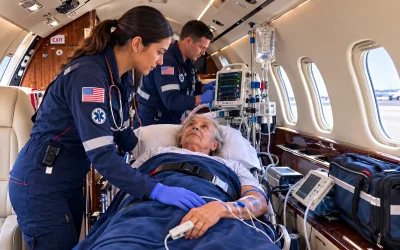
Depending on the case, planning may involve stretcher positioning, oxygen planning, secured medical equipment, monitoring, appropriate power support, direct patient access for the medical team, aircraft-specific loading and unloading arrangements, ground transportation when included, and coordination between the sending and receiving facilities.
Air Medical Transport provides complete bed-to-bed fixed-wing air ambulance transport management for patients traveling to or from hospitals, cancer centers, rehabilitation hospitals, and other specialty facilities when fixed-wing air ambulance transport is determined to be appropriate by the patient’s treating physicians and care teams and is operationally feasible based on the information provided.
Our Flight Coordinator Specialists manage each transport through selected FAA Part 135 and/or EASA-certified fixed-wing air ambulance operators. Families, hospitals, and care teams receive clear communication, transport planning guidance, and a single point of contact from the first call through arrival at the receiving facility or destination.
What Information Helps the Review
The review usually begins with the patient’s condition, current location, destination facility, requested timing, and any known medical support needs.
Useful information may include:
- patient condition and current care setting
- sending and receiving facility details
- physician or care-team guidance
- receiving-facility acceptance or contact details when applicable
- oxygen, monitoring, equipment, positioning, or isolation needs
- mobility, stretcher, bariatric, pediatric, neonatal, geriatric, palliative, hospice, or other special transport considerations
- requested timing and any documentation needs
You do not need every detail to begin. In many cases, accurate patient information, sending and receiving facility contact information, and the most recent medical report are enough to begin the review process. If the latest medical report is available, please send it with the request. Otherwise, with appropriate patient authorization and facility cooperation, our Flight Coordinator Specialists can often obtain additional records and information directly from the treating facility as needed. For a practical overview, review What Information Is Needed for a Fixed-Wing Air Ambulance Quote and Case Review?.
What This Means for Families and Care Teams
If a specialty center is involved, it is understandable to focus first on the destination. The destination facility matters. The transport environment matters as well.
A patient who needs specialty care may require more than a route from one place to another. The transfer may need medical support, careful timing, facility alignment, and a coordinated bed-to-bed plan.
The goal is to make the transport match the patient’s real needs so the family and care team can move forward with clearer expectations.
What Happens Next
If a patient may need long-distance or international transport to or from a specialty center, begin with a fixed-wing air ambulance review.
You do not need full details to begin. Start with your contact details, the patient’s condition, location, destination, and specialty facility involved when applicable.
For a specialty-center service overview, review Fixed-Wing Air Ambulance to and from Specialty Centers. For the full transport sequence, review What Happens During a Complete Bed-to-Bed Fixed-Wing Air Ambulance Transport.
Medical Disclaimer
This content is for informational purposes only and does not replace medical advice. Fitness for air travel should be determined by the patient’s treating medical team.
Reviewer
Reviewed for operational accuracy by:
Xavier Paz
Director / CEO, Air Medical Transport
Review scope:
Fixed-wing air ambulance transport management, medical logistics coordination, aviation coordination, and operational accuracy.
Review date:
September 1, 2026


0 Comments