


When a patient needs long-distance medical transport, families and care teams often want to understand the full sequence before making a decision.
A complete bed-to-bed fixed-wing air ambulance transport is not just the flight. It is a coordinated transport plan that connects the sending location, ground transfer when included, airport logistics, fixed-wing air ambulance flight, destination ground transfer when included, and receiving location into one managed process.
Air Medical Transport provides complete bed-to-bed fixed-wing air ambulance transport management so families and care teams have one dedicated point of contact instead of trying to coordinate each part alone.
Quick Answer
During a complete bed-to-bed fixed-wing air ambulance transport, the process usually moves from case review and quote preparation to booking details, documentation review, agreement and payment steps, verification, scheduling, origin coordination, fixed-wing air ambulance transport, destination coordination, and arrival updates.
The exact sequence depends on the patient’s condition, physician guidance, sending and receiving facility timing, aircraft suitability, routing, weather, documentation, permits when applicable, airport suitability, and aircraft, flight crew, medical team, and operational availability at the time of booking.
What Bed-to-Bed Means in Practice
Bed-to-bed planning focuses on continuity from the patient’s origin to the receiving destination.
Depending on the transport plan, this can include coordination with the sending facility or residence, ground transportation to the departure airport, the fixed-wing air ambulance flight, ground transportation from the arrival airport, and communication with the receiving facility or destination contact.
The goal is to reduce gaps between transport segments, keep authorized parties informed, and help the patient move through the journey with a clear plan rather than a series of disconnected steps.
Initial Review and Quote Preparation
The process usually begins with a review of the patient’s condition, location, destination, timing needs, and available transport details. If you are still deciding whether this level of transport may fit the situation, review When Is Fixed-Wing Air Ambulance Transport Appropriate?.
Useful information may include:
- patient condition and current care setting
- origin and destination
- sending and receiving facility contacts, if applicable
- physician or care-team guidance
- oxygen, monitoring, equipment, positioning, or isolation needs
- mobility, stretcher, bariatric, or transfer requirements
- passport, visa, or documentation needs for international transport
- requested timing and any known constraints
This information helps identify the fixed-wing air ambulance options, planning requirements, and clear next steps needed for a quote.
Booking, Verification, and Scheduling
After the quote is reviewed and the responsible party decides to proceed, booking details and required documentation are submitted for formal review.
Booking and scheduling remain subject to transport-specific requirements, including patient condition, physician guidance, aircraft suitability, medical team configuration, routing, weather, documentation, airport suitability, applicable regulatory requirements, and availability at the time of booking.
Complete the required payment or the approved preauthorization per the booking requirements. Booking and transport arrangements proceed after the required agreement and payment steps are completed, credited, or properly pre-authorized.
After details are verified and scheduling is complete, Air Medical Transport provides the Programmed Flight Itinerary and ongoing updates to authorized parties.
Origin Coordination
Before departure, coordination focuses on the sending location and the first transport segment.
That may include facility timing, patient readiness, medical documentation, transfer preparation, ground transportation when included, airport selection, loading arrangements, and communication with the appropriate care teams.
For hospital-to-hospital, rehabilitation, specialty-center, residential, or international transports, the origin segment matters because delays or missing information early in the process can affect later timing.
The Fixed-Wing Air Ambulance Flight
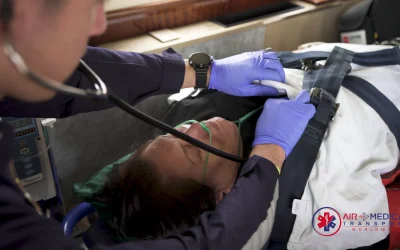
A fixed-wing air ambulance is medically configured for patient transport.
Depending on the case, the transport plan may involve stretcher positioning, oxygen planning, secured medical equipment, monitoring, appropriate power support, direct patient access for the medical team, and aircraft-specific loading and unloading arrangements.
Our Flight Coordinator Specialists manage each transport through selected FAA Part 135 and/or EASA-certified fixed-wing air ambulance operators, coordinating transport planning, medical logistics, and regulatory requirements.
Clinical decisions remain with the patient’s treating physicians and appropriate care teams. The aircraft, medical team configuration, equipment, route, and timing must align with the patient’s condition and the transport requirements.
Destination Coordination and Arrival
Arrival planning focuses on the receiving side of the transport.
This may include destination airport coordination, ground transportation when included, receiving facility timing, clinical handover expectations, and updates to authorized family members, care teams, or international care partners when applicable.
The goal is continuity through arrival, not only completion of the flight.
Why One Point of Contact Matters
Complete bed-to-bed fixed-wing air ambulance transport can involve many moving parts: family communication, sending and receiving facilities, medical documentation, ground transportation, aircraft suitability, routing, weather, permits, customs, and timing.
Families should not have to manage those details alone while also worrying about the patient.
A dedicated Flight Coordinator Specialist helps keep the process organized, explains what is needed, and provides clear updates so authorized parties understand where the transport stands and what happens next.
What This Means for Families and Care Teams
If you are trying to understand how the entire transport comes together, that is a reasonable concern. The flight is only one part of the journey.
The most important planning question is whether the patient’s needs, origin, destination, timing, documentation, clinical support, and transport segments can be aligned into one safe, realistic plan.
Complete bed-to-bed fixed-wing air ambulance transport management is designed to bring structure, accountability, and clarity to that process.
What Happens Next
If a patient may need long-distance or international transport with coordinated bed-to-bed planning, begin with a fixed-wing air ambulance review.
You do not need full details to begin. Start with your contact details, the patient’s condition, location, and destination, and we will help identify the information needed for a quote.
In many cases, accurate patient information, sending and receiving facility contact information, and the most recent medical report are enough to begin the review process. If the latest medical report is available, please send it with the request. Otherwise, with appropriate patient authorization and facility cooperation, our Flight Coordinator Specialists can often obtain additional records and information directly from the treating facility as needed.
For a practical overview of quote and review details, see What Information Is Needed for a Fixed-Wing Air Ambulance Quote and Case Review?.
For a fuller overview of the quote, booking, payment, verification, scheduling, and transport-monitoring sequence, review the fixed-wing air ambulance process.
Medical Disclaimer
This content is for informational purposes only and does not replace medical advice. Fitness for air travel should be determined by the patient’s treating medical team.
Reviewer
Reviewed for operational accuracy by:
Xavier Paz
Director / CEO, Air Medical Transport
Review scope:
Fixed-wing air ambulance transport management, medical logistics coordination, aviation coordination, and operational accuracy.
Review date:
August 20, 2026


0 Comments