


When someone you love needs to travel after illness, injury, surgery, or a major change in condition, it is natural to ask whether a commercial flight is still possible.
Being stable enough to travel does not always mean a standard passenger journey is the right fit.
For some medically stable passengers, commercial travel may remain appropriate with treating-team guidance. But when the patient may need oxygen support, monitoring, stretcher transport, isolation precautions, controlled positioning, or hands-on medical access during the journey, the question is no longer only whether the patient can board a plane. It is whether commercial travel is still the right environment for that patient.
Quick Answer
Commercial air travel may no longer be appropriate when the patient’s needs exceed what a standard passenger journey can reasonably support without creating avoidable risk, delay, or a gap between the patient’s needs and the support available during transport.
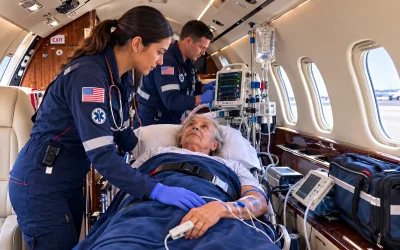
That decision should remain guided by the patient’s treating medical team. When commercial travel may not fit the patient’s condition or transport needs, a fixed-wing air ambulance review can help clarify whether a medically configured transport environment should be considered.
Why Commercial Travel Can Become the Wrong Fit
Commercial flights are designed for passengers. They are not built around stretcher transport, continuous patient access, medical equipment securement, or transport planning for patients who may need a controlled medical environment during flight.
Airline cabin crews are trained for passenger safety, basic first aid, and emergency response. They are not a dedicated medical team assigned to provide ongoing care for one medically vulnerable patient throughout a long journey.
Even when a patient appears stable before travel, ground stability alone does not always predict how a medically vulnerable passenger will tolerate flight. Cabin pressure, oxygen availability, dry air, limited mobility, travel duration, and access limitations can affect medical needs differently once airborne.
Commercial travel also has practical limits that matter for medically vulnerable patients. Some passengers may need to remain seated upright during required phases of flight, move through a long airport process, rely on limited onboard assistance, or arrange oxygen under airline-specific rules before departure. A commercial aircraft’s emergency oxygen systems are not the same as planned supplemental oxygen for a patient’s ongoing medical needs. Commercial medical-oxygen options are device-specific and can be limited; passengers generally cannot bring their own compressed oxygen, airlines are not required to provide oxygen service, and portable oxygen concentrator capability varies by model. When a patient cannot safely tolerate those demands, cannot manage essential personal needs with the support available in passenger travel, already needs substantial oxygen support, or may require medical support beyond what the airline can provide, commercial flight may no longer be the right environment.
The more a patient’s safety depends on oxygen planning, positioning, monitoring, transfer support, infection-control considerations, or rapid access to care during the journey, the more important it becomes to ask whether standard commercial travel still matches the patient’s needs.
Situations That May Need a More Careful Review
Commercial air travel may need closer review when the patient:
- requires oxygen support that may exceed what can be appropriately arranged through normal commercial-travel options
- requires monitoring or may need clinical access during the journey
- cannot sit upright safely for the duration of travel
- needs stretcher transport
- is bed-bound, severely weak, or unable to move safely through normal boarding, seating, or transfer steps
- is recovering from major surgery or recent serious illness
- has cardiopulmonary disease, anemia, respiratory illness, or other medical fragility that may be affected by flight conditions
- is receiving cancer treatment or is significantly immunocompromised, especially when exposure risk or overall transport tolerance needs closer review
- has a suspected communicable illness or requires isolation precautions that may make shared passenger travel unsuitable
- may deteriorate during transport or needs a level of observation beyond routine passenger travel
These are not self-diagnosis rules. They are reasons to involve the treating team early and review whether the planned travel environment is appropriate for the patient’s actual condition.
When Body Size and Transfer Fit Need Early Planning
Body size and transfer requirements can also affect whether standard travel options are appropriate. When a patient’s weight, width, mobility, or transfer needs may exceed routine equipment or loading-path limits, early review is important before transport planning moves forward.
That review helps confirm that the stretcher, loading path, aircraft configuration, and transport resources are appropriate before an aircraft and team are committed. It can also help reduce avoidable patient-safety risk, unsuitable equipment selection, re-planning, transport delay, and possible added cost later if a different aircraft or team is required.
For patients weighing 300 lb (136 kg) or more, please complete our Fit Assessment for Bariatric Transports form to help us assess the most appropriate transport options.
Why Prevention Before Departure Matters
The most important planning question is not only what is expected to happen during the trip. It is what the patient may need if the journey becomes harder than expected.
If a patient’s condition changes in flight, additional equipment or a higher level of care beyond what is already onboard cannot be provided until landing, and any diversion still depends on available safe landing options.
When the patient may need more than a standard passenger environment can provide, proactive planning before departure is more protective than trying to solve avoidable problems after the journey has already begun.
What This Means for Families and Care Teams
If you are unsure whether commercial travel still fits the patient’s needs, that is completely understandable. These decisions are often made under pressure, and the right choice is not always obvious at first.
The goal is not to make travel more complicated than necessary. It is to match the transport environment to the patient’s real condition, reduce avoidable risk, and help families and care teams make a clear next decision with the treating team involved.
What Happens Next
If the patient may need oxygen support, monitoring, stretcher transport, isolation precautions, controlled positioning, or a medically configured transport environment during flight, begin with a fixed-wing air ambulance review.
Our Flight Coordinator Specialists manage each transport through selected FAA Part 135 and/or EASA-certified fixed-wing air ambulance operators.
For a fuller overview of how transport planning works, review the fixed-wing air ambulance process.
Medical Disclaimer
This content is for informational purposes only and does not replace medical advice. Fitness for air travel should be determined by the patient’s treating medical team.
Reviewer
Reviewed for operational accuracy by:
Xavier Paz
Director / CEO, Air Medical Transport
Review scope:
Fixed-wing air ambulance transport management, medical logistics coordination, aviation coordination, and operational accuracy.
Review date:
August 10, 2026


0 Comments